9 Themes. One Mission. The Big Ideas Driving ORP-5
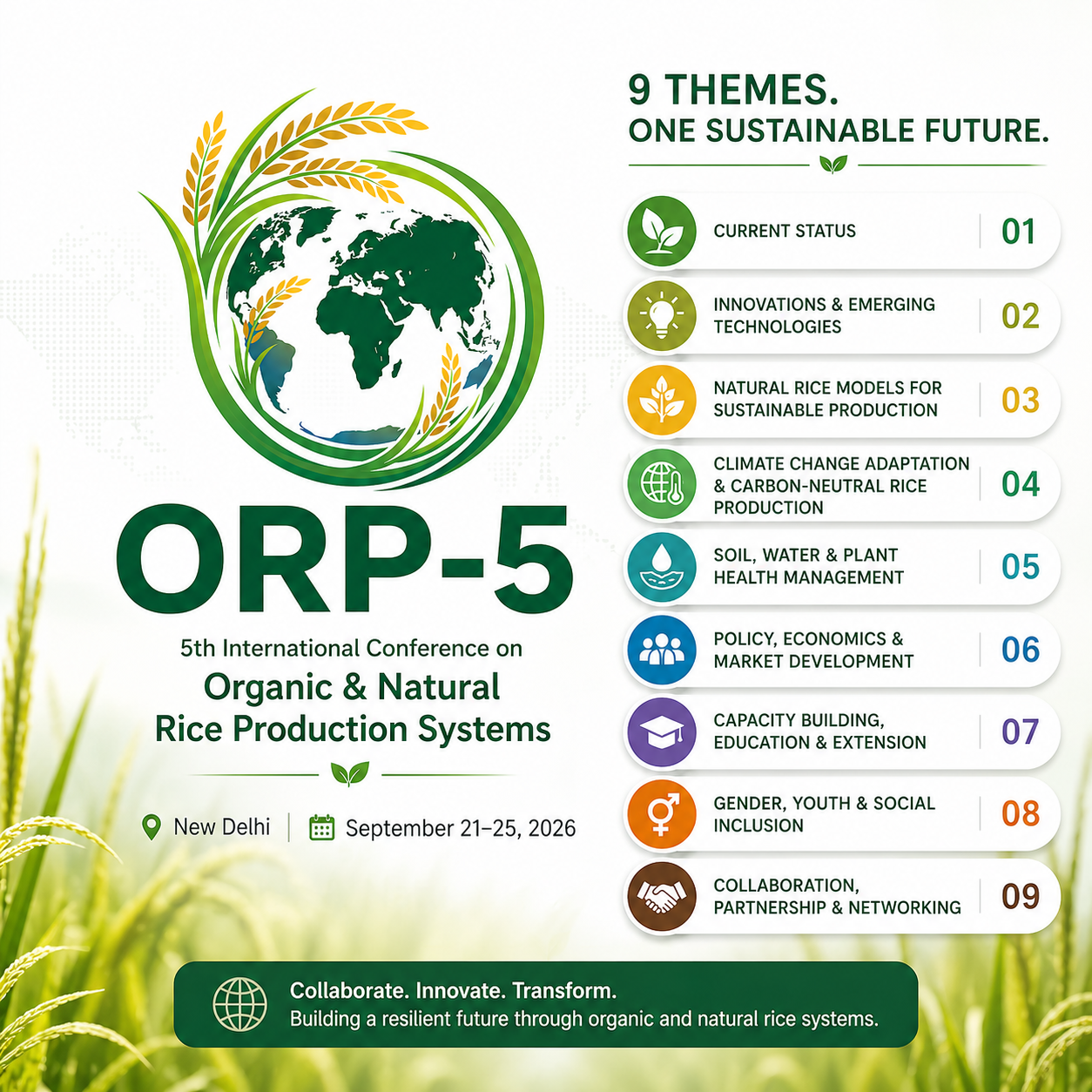
5th International Conference on Organic & Natural Rice Production Systems · New Delhi · September 21–25, 2026
Rice feeds more than half of humanity. Yet most of the world's rice is grown using methods that degrade soil, pollute waterways, and emit significant greenhouse gases. The shift toward organic and natural production isn't just an agronomic preference — it's one of the most consequential transitions in food systems today. ORP-5's nine themes map the full terrain of this transition: where we are, what's possible, and what stands in the way.
The 5th International Conference on Organic and Natural Rice Production Systems isn't built around a single question — it's organised around nine interconnected challenges that together define the future of sustainable food. Here is what each theme covers, why it matters, and what kind of research and conversations it will draw in.
Theme I — Organic and Natural Rice Production Systems: Current Status
Subtopics: Existing organic practices assessment · Field performance & yield stability · Farmer-level experiences · Agro-ecological diversity
Before you can chart a path forward, you need an honest map of where you are. Theme I is a grounding exercise — a global inventory of what organic and natural rice production actually looks like on the ground across diverse agro-ecologies, from the flooded paddies of Southeast Asia to the dryland systems of sub-Saharan Africa.
This theme asks the uncomfortable questions that ambitious discourse often sidesteps: Do current organic systems actually deliver on their promises? Are yield gaps between organic and conventional production acceptable? What do farmers themselves — the people whose livelihoods depend on this — report about real-world performance?
💡 Why this matters: Without an honest baseline, every innovation is built on assumption. Theme I is the empirical foundation that gives the rest of the conference its scientific credibility.
Theme II — Innovations and Emerging Technologies in Organic Rice Production
Subtopics: Bio-inputs & biofertilizers · Biopesticides · Farmer innovations · International case studies · Cost-effective models
This is the showcase floor of ORP-5 — where researchers, agri-entrepreneurs, and farmer-innovators bring their most exciting new tools and approaches. From cutting-edge biofertilizers developed in laboratories to low-cost, farmer-developed innovations that work precisely because they are not high-tech.
The scope is deliberately wide. A breakthrough biostimulant developed in a university lab in Italy is as welcome here as a composting method a rice farmer in Odisha has been quietly perfecting for a decade. What unites them is a single principle: what works, organically?
💡 The counter-intuitive reality: Some of the most impactful innovations in organic rice don't come from laboratories — they emerge from farmer ingenuity in resource-constrained environments. ORP-5 takes both seriously.
Theme III — Natural Rice Models for Sustainable Production
Subtopics: Zero Budget Natural Farming (ZBNF) · Ecological farming · Regenerative approaches · Livestock integration · Diversified farming systems
While Theme II is about innovations within existing frameworks, Theme III challenges the frameworks themselves. Zero Budget Natural Farming — championed in India and gaining global attention — argues that nature already provides everything needed for productive rice cultivation: no external inputs, no purchased fertilisers, no debt cycles.
This theme also examines the integration of livestock and crop diversification: the traditional intercropping, fish-rice systems, and duck-rice systems that modern monocultures dismantled — and that regenerative agriculture is now rediscovering.
"The shift toward regenerative and ecological farming isn't merely agronomic — it's a philosophical reorientation of the relationship between farmer, land, and community."
— ORP-5 Theme III Framework
Theme IV — Climate Change Adaptation and Carbon-Neutral Rice Production
Subtopics: Climate-resilient production systems · Mitigation strategies · Carbon budgeting · Low-emission rice production
Rice paddies are responsible for a significant share of global methane emissions — a fact that sits uncomfortably with the crop's role as humanity's most important food staple.
Theme IV confronts this tension directly. It asks: can rice production be made not just less damaging, but genuinely carbon-neutral?
Beyond mitigation, this theme addresses adaptation. As monsoon patterns shift, droughts intensify, and extreme weather events multiply, rice farming systems calibrated to historical conditions must be fundamentally reimagined. What varieties, methods, and water management practices will still be viable in 2050?
🌡 Key fact: Flooded rice paddies contribute approximately 10% of global agricultural methane emissions. Organic systems and alternate wetting-and-drying (AWD) techniques offer measurable reductions — and are central to this theme's research agenda.
Theme V — Soil, Water and Plant Health Management
Subtopics: Soil fertility & organic nutrients · Soil microbiome · Alternate Wetting and Drying (AWD) · Carbon sequestration · IPM for pests, diseases, and weeds
The soil beneath a rice field isn't just a growing medium — it's a living ecosystem of billions of microorganisms whose health determines the health of everything that grows above. Theme V brings this subterranean world into the scientific spotlight.
Alternate Wetting and Drying (AWD) — a water management innovation that reduces water use by up to 30% without yield loss — is one of the most significant practical contributions emerging from this space. So is the science of carbon sequestration in paddy soils: the possibility that organic rice fields can be net carbon sinks, not sources.
💡 The underrated insight: Integrated Pest, Disease and Weed Management in organic systems doesn't mean tolerating pests — it means designing systems where ecological balance prevents population explosions in the first place. It's management by design, not chemical rescue.
Theme VI — Food Quality, Nutrition and Human Health
Subtopics: Grain quality & food safety · Nutritional attributes · Residue-free production · Traceability · Health impacts & consumer perceptions · Fortified organic rice
Is organic rice actually better for you? This is the question millions of consumers are quietly asking — and that Theme VI is dedicated to answering rigorously. The research here examines grain quality, nutritional profiles, residue levels, and health outcomes associated with organic versus conventionally grown rice.
Critically, this theme also addresses traceability — the chain of verification that connects a consumer's purchase back to a specific farmer, field, and production method. In a world where greenwashing is rampant, credible traceability is what separates a genuine premium organic product from an expensive marketing claim.
Value addition and fortification represent an exciting frontier: organic rice as a platform for delivering essential micronutrients to populations where deficiency is endemic.
Theme VII — AI-Driven Mechanisation and Digital Intelligence for Organic Rice
Subtopics: Artificial Intelligence · Data Analytics · IoT sensors · Precision Farming · Smart Decision Support Systems
This is perhaps the most surprising and forward-looking theme in ORP-5 — and the one that signals most clearly how the conversation has matured. Five years ago, "organic farming" and "artificial intelligence" barely appeared in the same sentence. Today, they are inseparable.
AI-powered crop disease detection, IoT soil sensors that guide irrigation in real time, drone-based yield estimation, and decision-support apps that help farmers navigate complex organic certification requirements — these are not futuristic fantasies. They are being piloted in fields right now.
The challenge this theme addresses is integration: how do you combine the ecological wisdom of organic systems with the analytical power of digital technology, without losing what makes organic farming fundamentally different from data-driven industrial agriculture?
💡 The compelling paradox: Organic farming is, at its core, about working with natural systems rather than overriding them. AI, done right, might be the most powerful tool yet for understanding and supporting those natural systems — not replacing them.
Theme VIII — Scaling, Value Chains, and Market Opportunities
Subtopics: Scaling up organic production · Sustainable supply chains · Branding & certification · Export potential · Domestic market development
The hardest problem in sustainable agriculture isn't scientific — it's economic. Organic rice systems can be ecologically superior, nutritionally richer, and socially beneficial. None of that matters if they cannot reach consumers at prices that work for both farmers and buyers.
Theme VIII is where agri-economics meets agronomy. It examines how sustainable supply chains are built and maintained, what it actually takes to get organic certification (and keep it), and how Indian organic rice can compete on global export markets — while also ensuring domestic consumers have access.
For entrepreneurs, this is the business opportunity session. For researchers, it is the real-world stress test of every innovation presented across the other eight themes.
Theme IX — Policy, Institutions, and Capacity Building: Youth & Farmers' Perspectives
Subtopics: Policy frameworks · Certification standards · Regulatory challenges · Capacity building · Youth & startups · Farmer training & extension
The most technically perfect organic production system is worthless if the policy environment does not support it — or if farmers lack the knowledge and resources to adopt it. Theme IX is about the institutional infrastructure that either enables or prevents transformation at scale.
The explicit inclusion of youth and entrepreneurship is one of the most important design choices in this year's conference. ORP-5 recognises that the next generation of agricultural scientists, startup founders, and farm entrepreneurs are not just beneficiaries of current policy — they are the architects of future systems. Their voice, their energy, and their innovations belong at the centre of the conversation.
The regulatory and certification landscape for organic agriculture remains fragmented, costly, and often inaccessible for smallholder farmers. Theme IX asks what institutional reforms are needed to make organic certification a tool of inclusion rather than exclusion.
"ORP-5 aims to strengthen the international innovation and knowledge network on sustainable rice production systems — and to explore the challenges and consequences of scaling up across the agri-food value chain."
— ORP-5 Official Conference Objectives
Nine Themes. One Urgent Question.
In 2050, humanity will need to feed nearly 10 billion people — most of them in Asia, most dependent on rice. Will the systems that feed them restore the earth, or exhaust it?
ORP-5 is where the world's best minds — in labs, in fields, in policy chambers — gather to answer that question together. These nine themes are not separate conversations. They are nine dimensions of a single, urgent challenge: making rice production sustainable, just, and resilient for the generations that follow.
Of these nine themes, which one keeps you up at night — not with anxiety, but with possibility? That's probably exactly where your next research question lives.
👉 Join the Conversation — Register at orp5ic.com →
Deadline: August 1, 2026
ORP-5 · 5th International Conference on Organic and Natural Rice Production Systems · NASC Complex, New Delhi, India · September 21–25, 2026 · www.orp5ic.com · info@orp5ic.com