The Future of Food: Why the World’s Most Important Grain Is Evolving in 2026
Rice sustains more than half of the global population, making its future central to food security, climate resilience, and environmental sustainability. As chemically intensive production systems face increasing scrutiny, the transition toward organic and natural rice cultivation has become a strategic imperative rather than a niche alternative. The 5th International Conference on Organic and Natural Rice Production Systems (ORP‑5), scheduled for 21–25 September 2026 at the NASC Complex, New Delhi, brings together scientists, policymakers, farmers, industry leaders, and innovators to advance evidence‑based, climate‑resilient solutions. The conference integrates themes ranging from carbon‑neutral production systems and soil health management to mechanization and digital solutions for sustainable rice farming. Through rigorous peer‑reviewed research, international collaboration, and hybrid participation, ORP‑5 aims to strengthen global knowledge networks and accelerate scalable transformation in rice systems. As agriculture adapts to 21st‑century challenges, ORP‑5 represents a pivotal platform shaping the sustainable future of the world’s most essential grain.
The Future of Food: Why the World’s Most Important Grain Is Evolving in 2026
Rice sustains more than half of the global population, making it central to food and nutritional security. However, the environmental and health impacts of chemically intensive production systems have accelerated the global shift toward organic and natural rice cultivation. Sustainable transformation is no longer optional — it is strategic.
The 5th International Conference on Organic and Natural Rice Production Systems (ORP‑5), scheduled for 21–25 September 2026 in New Delhi, India, represents a major step in advancing climate‑resilient, scientifically grounded rice systems at scale.
A Decade of Global Collaboration
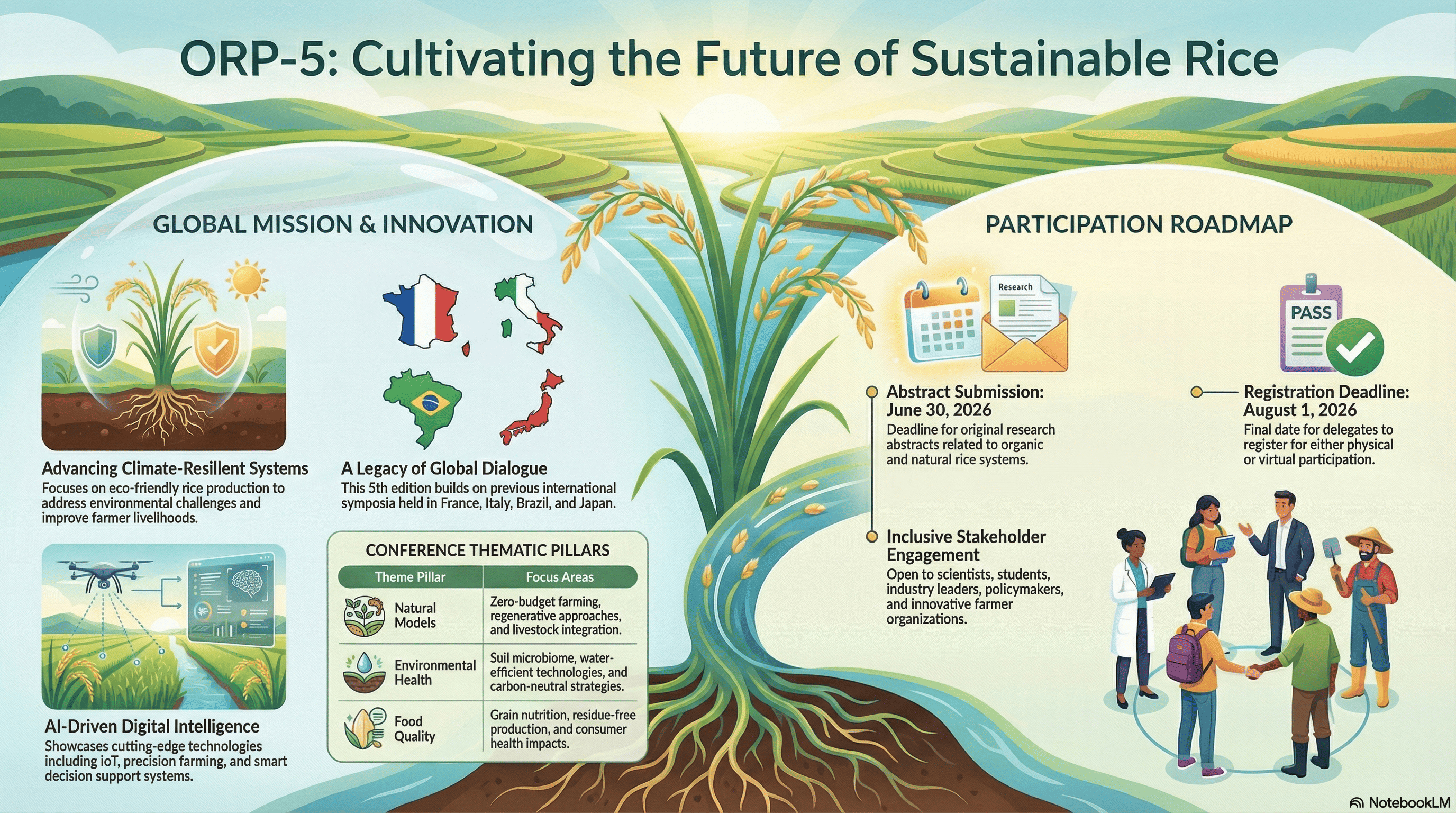
Since 2012, the International Symposia on Organic Rice Production Systems have been hosted in:
- France (2012)
- Italy (2015)
- Brazil (2018)
- Japan (2023)
With ORP‑5 convening at the NASC Complex, New Delhi, the dialogue now moves to one of the world’s largest rice‑producing and exporting nations. India offers a critical context to evaluate whether sustainable systems can perform under large‑scale production and market pressures.
This transition signals the evolution of the movement from exploratory research to structured international collaboration.
Mechanization and Digital Solutions in Organic Systems
Organic agriculture is no longer framed as a return to the past.
Under Theme VII: Mechanization and Digital Solutions for Organic Rice Production Systems, ORP‑5 addresses:
- Farm mechanization in organic systems
- Digital agriculture and ICT tools
- Smart advisory systems
- Labour efficiency and cost‑reduction strategies
Scaling organic systems requires precision. Digital tools enable improved soil monitoring, optimized resource use, and better decision support — strengthening productivity while maintaining ecological integrity.
High‑tech and organic are not contradictory; they are increasingly complementary.
Climate Adaptation and Carbon‑Neutral Pathways
Rice cultivation contributes significantly to methane emissions, making climate adaptation essential.
ORP‑5 integrates:
- Theme IV: Climate Change Adaptation and Carbon‑Neutral Rice Production Systems
- Theme V: Soil, Water, and Plant Health Management
Particular emphasis is placed on water‑efficient practices such as Alternate Wetting and Drying (AWD), improved soil health management, and carbon budgeting.
These approaches reposition rice systems as part of the climate solution, aligning production with global Sustainable Development Goals (SDGs).
Scientific Rigor and Peer Review
To ensure research quality and practical relevance, all submissions undergo a blind peer‑review process.
Researchers must submit original, unpublished abstracts (maximum 500 words) in English.
📅 Submission deadline: 30 June 2026
📩 Submissions: editor@orp5ic.com
This process safeguards scientific integrity and ensures that innovations presented are evidence‑based and scalable.
Inclusive and Hybrid Participation
ORP‑5 is jointly organized by AIASA, University of Agricultural Sciences Raichur, and IPB University (Indonesia), in collaboration with ICAR and SafeRock (UK).
The conference will operate in both physical and virtual modes, expanding access across geographies. Registration categories include scientists, policymakers, students, industry stakeholders, and innovative farmers — ensuring multi‑level knowledge exchange.
A Strategic Moment for Global Rice Systems
ORP‑5 is more than a conference. It is a platform for aligning science, policy, technology, and field practice toward resilient rice production systems.
As September 2026 approaches, the central question is not whether rice systems must evolve — but how effectively we can accelerate evidence‑based, scalable solutions.
The world’s most essential grain now stands at a pivotal moment. ORP‑5 aims to help shape what comes next.
Page Coordinator & Content Steward
Anand Kumar
Conference Content & Communications Team
ORP-5: International Conference on Organic & Natural Rice Production Systems 2026